


Under the premise that electronic products tend to be multi-functional and complicated, the line spacing of PCB boards is getting smaller and smaller, the speed of signal transmission is relatively increased, and high-density integration (HDI) technology can make the end product design more miniaturized. HDI Compared to conventional PCB technology, HDI boards use thinner line width/line spacing (≤ 2/2 mil), smaller holes (<0.15mm) and pads (< 0.4mm), and higher pad density (>20 pads /cm2). Vias in pad are often used in HDI boards, and the vias in pad require full plug holes, so the requirements for plug holes are becoming higher and higher. Such as: there should be no solder resistance ink into the hole, resulting trapped tin in the hole, the tin passes through the component through the through hole when PCB were wave soldering resulting in short circuit; No explosive oil resulting in SMT welding, etc.
Ink plug hole: Ink plug hole is used for ordinary through holes in PCB, after the hole is plugged, the surface is ink and will not conduct electricity. Usually after plugging the hole requirements: A, ink plugging must be sufficient, B, no redness or false exposure of copper phenomenon, C, do not plug protrusion higher than the welding pad (will affect SMT mounting).
Resin plug hole (POFV) : Resin plug hole simply means that after copper plating on the hole wall, the hole is filled with epoxy resin, and then the surface is ground flat, and then copper plating on the surface, the cost is higher.
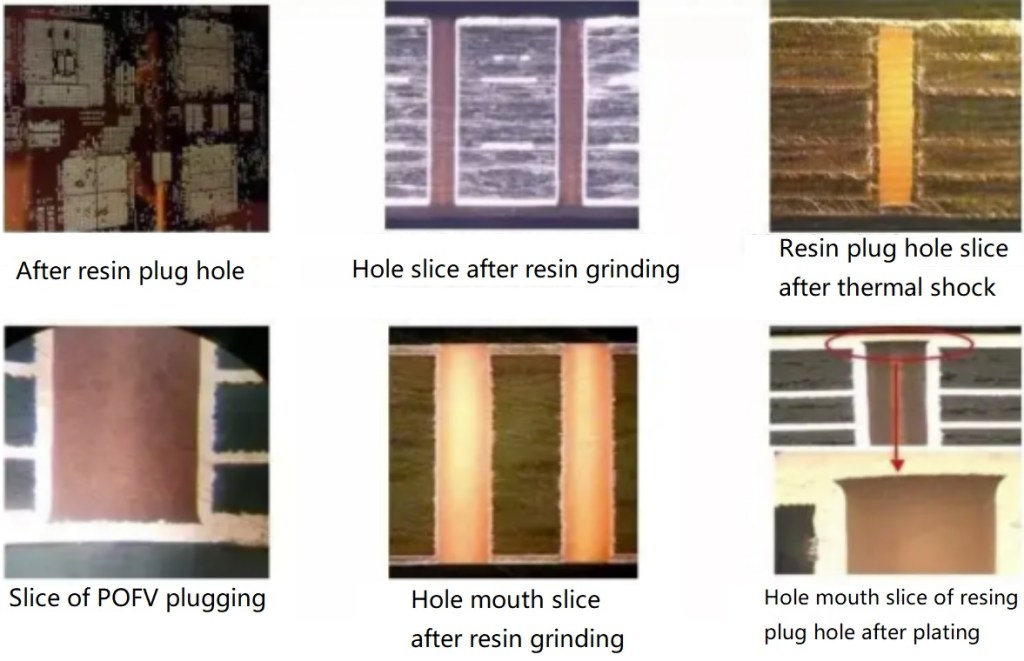
Blind hole (HDI) inner resin plug hole:
For some blind hole PCBs, because the thickness of the blind hole layer is greater than 0.5mm, PP lamination can not fill the blind hole, and it is also necessary to fill the blind hole with resin plug to avoid the problem of no copper in the blind hole in the subsequent process.
The difference between resin plug hole and green ink plug hole:
Before the resin plug process was not popular, PCB manufacturers generally used a relatively simple ink plug process, but the green ink plug hole will shrink after prep, and it is easy to have trapped air inside the hole, which can not meet the requirements of users with sufficient fullness. The resin plugging process uses resin to plug the HDI hole and then laminate it, which perfectly solves the disadvantages caused by the green ink plugging hole, and balances the contradiction between the thickness control of the dielectric layer of lamination and the design of the inner HDI hole plugging. Although the process of resin plugging is relatively complex and the cost is high, it has more advantages than ink plugging in terms of fullness and quality.
 one stop ems solution
Leave a comment