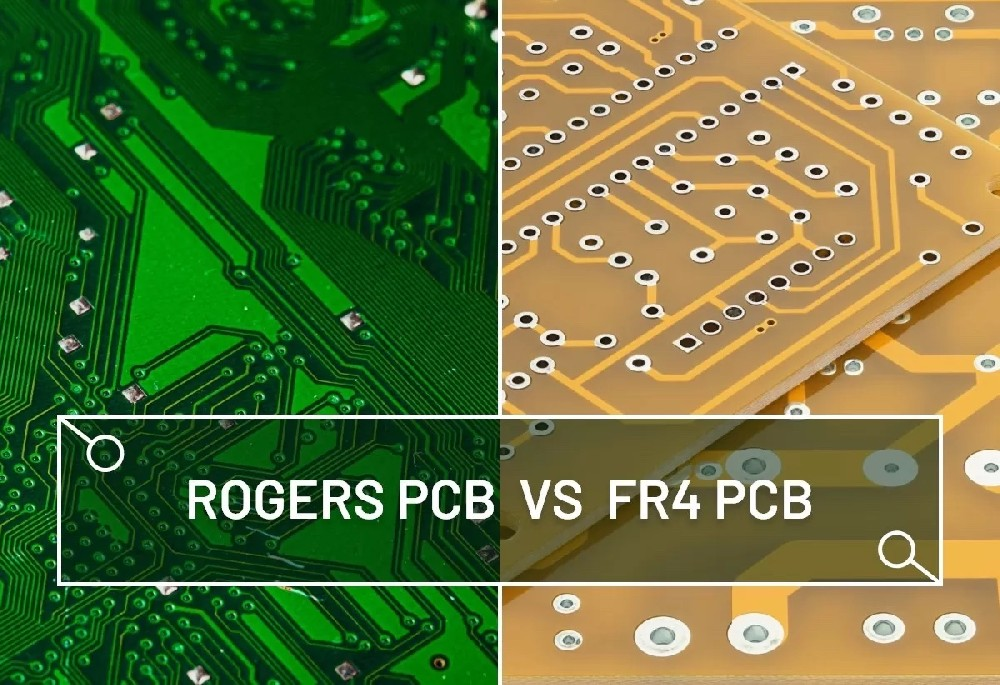

In the world of Printed Circuit Board (PCB) design, the substrate—the base material upon which your circuit is built—is the foundation of your product’s performance. For decades, FR-4 has been the undisputed champion of the industry. It is versatile, strong, and cost-effective. However, as we push into the era of 5G, automotive radar, and high-speed data centers, the limitations of standard materials are becoming apparent.
Choosing the wrong material isn’t just a budgeting error; it’s a functional failure. If you use standard FR-4 for a high-frequency application, your signal will degrade. If you use expensive Rogers material for a simple power supply, you are burning money.
This guide breaks down the physics, the costs, and the decision-making process to help you select the perfect substrate for your 2026 projects.
The Workhorse: Understanding FR-4
FR-4 (Flame Retardant 4) is a composite material made of woven fiberglass cloth impregnated with an epoxy resin binder. It is the standard for the vast majority of electronics, from computer motherboards to industrial controllers.
Why it’s popular:
- Cost: It is the most economical option available.
- Mechanical Strength: It offers excellent physical durability and insulation.
- Manufacturability: Almost every PCB factory in the world is optimized to process FR-4.
The Limitation:
Standard FR-4 is a “lossy” material at high frequencies. As signal speeds increase, the material absorbs more energy, turning it into heat. This is known as Dielectric Loss. Furthermore, the Dielectric Constant (Dk) of standard FR-4 is not perfectly stable; it fluctuates with frequency and temperature, which can cause impedance mismatches in high-speed circuits.
The Specialist: High-Frequency Materials
High-frequency laminates (such as those from Rogers, Taconic, or Isola) are engineered specifically to handle Radio Frequency (RF) and Microwave applications. These materials are often ceramic-filled or use specialized hydrocarbon resins.
Why they are necessary:
- Low Loss: They have a much lower Dissipation Factor (Df), meaning signals travel further with less attenuation.
- Stable Dk: The Dielectric Constant remains consistent across a wide frequency range (e.g., 1GHz to 40GHz). This stability is critical for maintaining controlled impedance.
- Thermal Management: Many high-frequency materials have better thermal conductivity, helping to dissipate heat from high-power RF components.
The Physics of Choice: Dk and Df
To make an informed decision, you must understand two key acronyms:
- Dielectric Constant (Dk or εr): This measures the material’s ability to store electrical energy.
- High Dk (FR-4 ~4.5): Slows down signal propagation. Good for miniaturization but bad for speed.
- Low/Stable Dk (Rogers ~3.0): Allows for faster signal transmission and consistent impedance.
- Dissipation Factor (Df or tanδ): This measures signal loss.
- High Df (FR-4 ~0.02): High signal loss. Acceptable for digital signals under 1-2 GHz.
- Low Df (High-Freq ~0.003): Minimal signal loss. Essential for mmWave and 5G.
Cost vs. Performance: The Trade-Off
The primary barrier to using high-frequency materials is cost. Rogers or Taconic laminates can cost 5x to 10x more than standard FR-4.
However, in 2026, we often see Hybrid or “Mix-Laminate” stack-ups. This involves using expensive high-frequency material only on the specific signal layers that need it (e.g., the top layer for an antenna), while using standard FR-4 for the power and ground planes. This balances performance with budget.
Material Selection Matrix
Use the table below to guide your material selection based on your project’s operating frequency.
表格
| Frequency Range | Application Examples | Recommended Material | Why? |
|---|---|---|---|
| DC – 1 GHz | Power Supplies, Audio, Simple Microcontrollers | Standard FR-4 | Cost-effective; signal loss is negligible at these speeds. |
| 1 GHz – 10 GHz | WiFi (2.4/5GHz), Bluetooth, GPS, Industrial IoT | Low-Loss FR-4 / Mid-Range Laminate | Standard FR-4 begins to lose too much signal. A “Mid-Loss” material (like Isola 370HR) is a good balance. |
| 10 GHz – 30 GHz | 5G Infrastructure, Automotive Radar (77GHz), Satellite Comms | High-Frequency Laminate (e.g., Rogers 4350B) | Requires stable Dk and very low loss to maintain signal integrity. |
| 30 GHz+ (mmWave) | Advanced Radar, Military Aerospace, High-Speed Data Links | Specialized PTFE / Ceramic | Extreme stability required. FR-4 is unusable here. |
Summary
For the majority of your designs—consumer electronics, controllers, and standard digital circuits—FR-4 remains the king of value. However, as soon as you introduce RF signals, high-speed data transmission, or strict impedance control requirements, you must upgrade your substrate.
The Golden Rule: If your signal rise time is fast, or your frequency is high, do not compromise on the material. The cost of a board failure in the field far outweighs the extra few dollars per square inch for high-quality laminate.